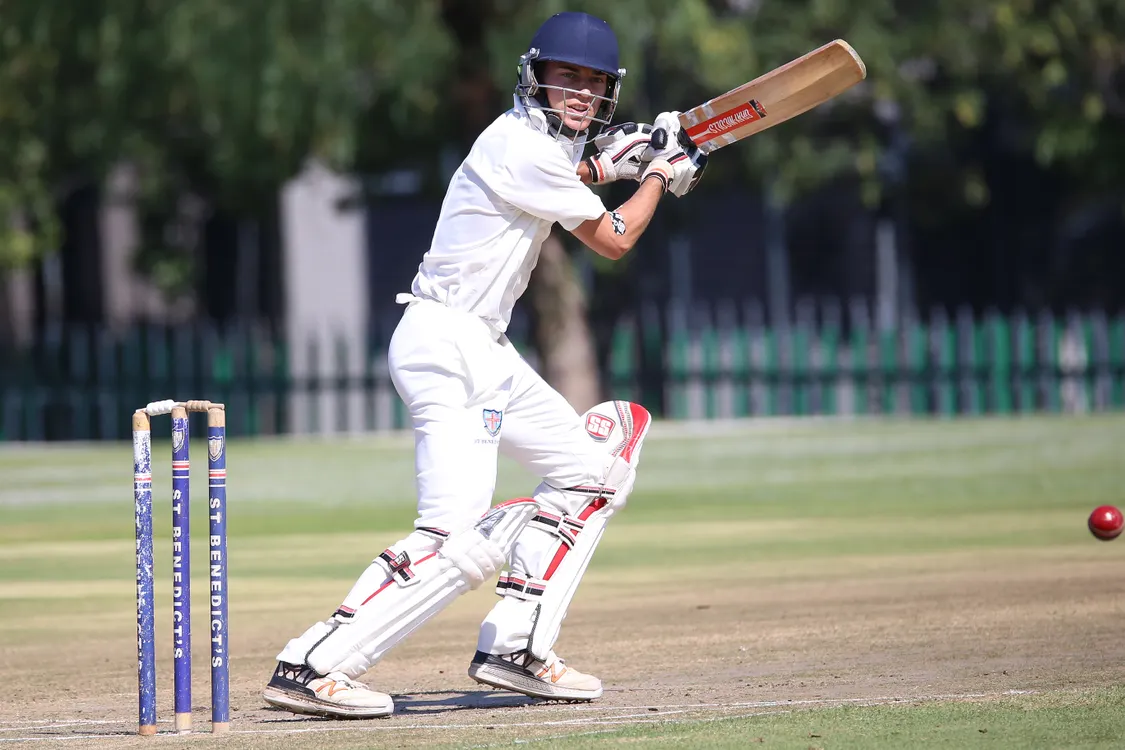
Direct answer: To grip a cricket bat correctly, put your top hand at the top of the handle and your bottom hand just below it, hands close together. Your thumb and forefinger on each hand should form a V pointing along the spine of the bat. Hold the bat in your fingers, not deep in your palms, and keep your grip light.
You can buy the best bat in the shop, but the only place your body touches it is the handle. Move your hands by a centimetre and the angle of the blade changes, your timing changes, and your strength reaches the ball differently. Good batters are fussy about their grip, and they are right to be. The grip is the base for everything else: footwork, head position and shot choice all get easier when the grip is sound.
This guide shows you the correct grip step by step, what each hand does, which rubber grip suits your game, how to fit a new grip, and the mistakes that undo good technique.
What each hand does
Your two hands have different jobs, and knowing them is the first step to a correct grip.
For a right-handed batter, the left hand sits at the top of the handle and the right hand sits below it. Left-handed batters swap the hands around. The top hand is the control hand. It guides the bat down, keeps the face square and lets you adjust late if the ball moves. The bottom hand is the power hand. It adds whip through the ball and helps you punch, pull and flick off the pads.
Most club batters are too bottom-hand dominant. It feels strong because it is strong, but it also closes the face early, makes you hit across the line and produces top edges when the ball seams or swings. The top hand should lead. The bottom hand should add the finish, not steer the shot.
How to grip a cricket bat, step by step
Follow these six steps in order. Do them slowly at first, in front of a mirror if you can.
1. Start with the top hand
Pick the bat up with the handle lying across your fingers rather than deep in your palm. The fleshy heel of your palm should rest against the back of the handle, not swallow it. If the handle is buried in your palm, you lose wrist movement and feel.
2. Find the V
Your thumb and forefinger form a V shape. On the top hand, that V should sit roughly along the inside edge of the blade, pointing towards the off side and down towards the toe. This is the V rule, and it is the single most important checkpoint in correct grip technique.
3. Sit the hand near the top of the handle
Place your top hand close to the top, but not jammed over the rubber cap. Gripping right at the end costs you a little control. Slipping down the handle costs you reach and leverage.
4. Add the bottom hand
Bring your bottom hand in directly below, so the hands touch or sit within about a finger’s width of each other. Its V lands more centrally on the back of the handle, pointing straight down the middle of the bat.
5. Check the blade
Hold the bat vertically in front of you with the face towards an imaginary bowler. Both wrists should feel relaxed and the blade should hang flat, not twisted towards fine leg or cover. If the face is closed or open, adjust the bottom hand first.
6. Set your pressure
Keep your grip light, especially in the top hand. Hold it firm enough that the bat will not spin, soft enough that your forearms are not working. Squeeze properly only as the ball arrives. A useful check: hold the bat as if you were holding a tube of toothpaste with the lid off. That is the pressure you want before contact.
Which cricket bat grip type should you choose?
The rubber grip on your handle is not just a sleeve. Its texture and thickness change how the bat feels in your hands. These are the five common types.
| Grip type | Texture and feel | Best for |
|---|---|---|
| Chevron | Thin, V pattern, maximum feel | Timing players who rely on precision and wrist freedom |
| Octopus | Thick, bubble cushioning, strong shock absorption | Fast bowling and long innings |
| Diamond | Raised diamond pattern, grip from many angles | All-round players who want balance |
| Ribbed or wave | Long ridges along the handle | Wristy batters who play delicate shots |
| Scale or dynamic | Mixed texture, moderate thickness | All-rounders across formats and surfaces |
For beginners, a chevron or scale grip is a good starting point. Both give balanced thickness and reliable traction without being too specialised, so you can build correct hand technique naturally.
Should you use a single grip or a double grip?
A double grip is a second rubber grip fitted over the first. It changes the feel of the handle, so choose on purpose, not by habit.
| Feature | Single grip | Double grip |
|---|---|---|
| Feel | More bat feel, lighter pickup | More cushioning, thicker handle |
| Weight | Lighter | Slightly heavier |
| Vibration | Moderate | Reduced |
| Best for | Timing players and technical batters | Power hitters and fast bowling |
A double grip fits most standard bat handles, but it adds thickness and a little weight, which can change the pickup and balance of your bat. Always test it in practice before using it in a match.
How to fit a new rubber grip
Fitting a grip is a simple job with the right tools. You need a grip cone, some talcum powder and, if you want it, a small piece of tape.
- Remove the old grip. Peel it off completely and wipe the handle clean so no residue is left.
- Powder the new grip. Dust talcum powder generously inside the new grip. This cuts friction and lets it roll on smoothly.
- Stretch it over the handle. Put the grip over the cone, stretch it open at the top and position it over the top of the bat handle.
- Unroll it downwards. Unroll the grip evenly down the handle in one smooth motion, keeping the tension even so it does not bunch.
- Align and secure. Press the base of the grip flat against the splice and tape the bottom edge if it needs holding in place.
If you do not have a cone, a rolled-up magazine or a smooth bottle can work as a stand-in, but a proper cone makes the job much easier and costs very little.
Common grip mistakes and how to fix them
| Mistake | What goes wrong | Fix |
|---|---|---|
| Bat buried in the palm | You lose wrist movement and feel | Roll the handle out so it sits across your fingers |
| White-knuckle grip | Stiff wrists, tired forearms, late bat speed | Hold at about three out of ten and tighten only at contact |
| Hands too far apart | Slower hands, more leading edges | Bring the bottom hand up until the hands touch |
| V pointing the wrong way | The face closes or opens early | Rotate the bottom hand so its V points down the middle of the blade |
| Bottom hand dominating | You hit across the line and lose shape | Practise top-hand-only drives for a week |
| Gripping too low or too high | Your balance and reach change | Find a spot near the top and mark it with tape until it feels automatic |
Change one thing at a time and give it at least two or three net sessions before you judge it. A new grip always feels wrong for a while, which is why so many players drift back into old habits after ten minutes.
Three quick checks you can do at home
The slide test. Hold the bat as you normally would. Ask someone to slide it out of your top hand with a gentle pull. If it will not budge without a fight, you are gripping too hard.
The look-down check. Hold the bat vertically with the face square. Look down at your hands. You should see a consistent V on each hand, the blade flat, and the two hands close together. A quick glance before you face a ball is enough.
The shadow drive. In front of a mirror, play twenty slow forward drives. Watch the back of your top hand. It should lead the bat down and stay behind the line of the ball. If your bottom hand is visibly pushing through first, reset and go again.
When to replace your grip
Replace your grip when it stops doing its job. The signs are easy to spot: the surface turns shiny or smooth, you can see cracks, or it slips in your hands during play. Many guides suggest replacing a grip after around 20 to 30 hours of play, but the condition of the rubber matters more than the hours. Wipe the grip with a dry cloth after every session to clear sweat, and store the bat somewhere dry, away from direct sunlight, so the rubber does not harden or crack early.
If you are working through a lasting problem with your grip, or you have wrist, hand or forearm pain, it is worth having a qualified coach look at you in person, and speaking to a health professional if the discomfort continues.
Frequently asked questions
Which cricket bat grip is best for beginners?
A chevron or scale grip suits most beginners. Both have balanced thickness and reliable traction, and neither is so specialised that it gets in the way of learning correct hand technique.
How often should I replace my cricket bat grip?
Many guides suggest every 20 to 30 hours of play. Replace it sooner if the surface becomes shiny, cracked or slippery, because a worn grip loses traction and lets more vibration reach your hands.
Can I use a double grip on any cricket bat?
Yes, a double grip fits most standard bat handles. It adds thickness and a little weight, so test it in practice first to check the pickup and balance still suit you.
Does the grip really affect shot timing?
Yes, a lot. Correct hand placement and V alignment keep the bat face straight at impact, which improves timing across drives, pulls and defensive shots. Poor grip technique is one of the leading causes of mistimed shots at every level.
What is the V grip rule in cricket?
The V rule is the alignment formed by the thumb and index finger of both hands, pointing towards the spine of the bat. It keeps the bat face straight and is the first thing to check when your grip feels wrong.
Should my hands be together or apart?
Close together is the better default for most batters, especially beginners, because it gives the most control and the quickest hands. A wider split gives more leverage but costs reaction time against a moving ball.
Conclusion
Gripping a cricket bat correctly is not a one-time adjustment. It is a habit you build and check before every net session: fingers, not palm; light, not vice-like; top hand leading, bottom hand adding the finish. Get the V right, pick a grip that suits your hands and your game, and replace it when it wears out.
Once your grip is set, the next step is getting the bat itself ready. Read our guide on how to knock in a cricket bat before you use a new bat in a match, and browse the sports section for more beginner guides.