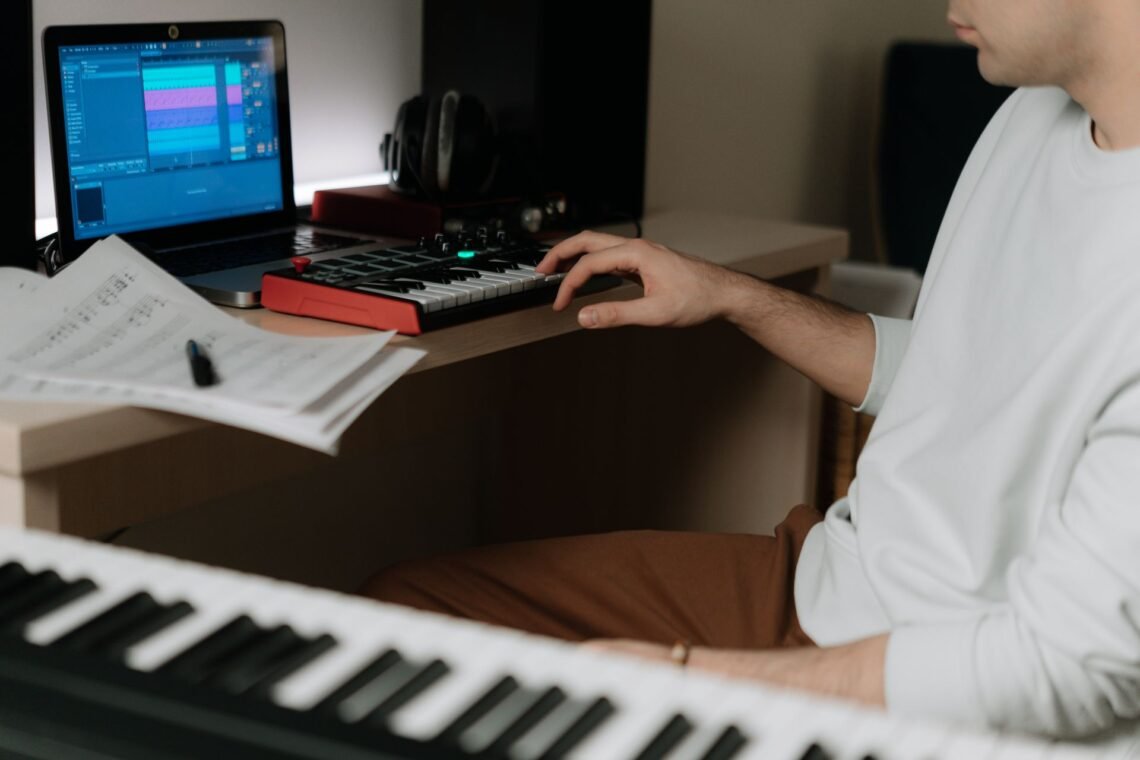
Direct answer: To start making music at home, pick one free music app, learn its basic tools, and finish one simple song. You need a computer or phone, headphones, and a free digital audio workstation such as GarageBand, Cakewalk or LMMS. You do not need an instrument, a studio or music theory to make your first track.
A laptop and a free app now give you drums, bass, synths and recording tools that once filled a room. The hard part is starting, finishing one track, and doing it again.
What you need to start
You need less than you think. A computer or a phone, a pair of headphones and one app are enough for your first song.
Headphones matter more than speakers when you start, because you can hear every detail and work anywhere. If you plan to record your voice or a live instrument, add a basic USB microphone later. A small MIDI keyboard is useful but not required; most apps let you play notes with your computer keyboard or draw them in with a mouse.
| Item | Do you need it first? | Why |
|---|---|---|
| Computer or phone | Yes | Runs your music app |
| Headphones | Yes | Hear every detail, work anywhere |
| USB microphone | Later | Only for recording voice or a live instrument |
| MIDI keyboard | No, optional | Handy for notes, but you can draw them in |
Which free software should you use for your first song?
A digital audio workstation, or DAW, is the app where you record, arrange and mix your music. Several good ones cost nothing.
| Software | Platform | Best for |
|---|---|---|
| GarageBand | Mac and iPhone | The easiest start, built in loops and instruments |
| Cakewalk | Windows | A full professional DAW for free, good for recording |
| LMMS | Windows, Mac and Linux | Beat making and electronic music on any system |
| BandLab | Phone, tablet and browser | Making songs on the go and sharing them |
| Audacity | Windows, Mac and Linux | Simple recording and editing, not a full DAW |
A little music theory goes a long way
You only need a small part of music theory to start. A few basics will help you write melodies and chords that sound good together.
Start with scales. A scale is a set of notes that fit together, and most songs use one scale from start to finish. Major scales sound bright, minor scales sound darker. Learn the C major scale first, because it uses only the white keys on a piano.
Next, learn chords. A chord is three or more notes played together, and a chord progression is the sequence of chords under a song. Most pop songs use only three or four chords. Try the progression C, G, Am and F, and you will recognise it from dozens of songs you already know.
Finally, learn about rhythm. Most modern music uses four beats in a bar. Place your kick drum on beats one and three, your snare on beats two and four, and you have the skeleton of a song.
How to write your first song
Break the job into small steps and do them in order.
1. Pick a mood and a tempo
Decide how the song should feel before you touch an instrument. A slow tempo suits a sad or calm song, a fast tempo suits an energetic one. Write the mood down in one sentence and keep it in front of you.
2. Start with a beat or a melody
Start with whichever comes first. Some people begin with a drum pattern, others with a melody hummed into their phone. Try a simple drum loop, then play a few notes over it until something sounds good.
3. Add a bass line
A bass line follows the root notes of your chords and gives the song weight. Keep it simple. One note per chord, played on the beat, is enough for a first song.
4. Arrange it into a song
A simple song structure is verse, chorus, verse, chorus. Copy your loop into sections, remove the drums from the first verse so it feels quieter, and bring everything back for the chorus. The contrast between quiet and loud is what makes a song feel like a song.
5. Export and listen away from your desk
Export the track as an audio file and listen to it on your phone or on a walk. You will hear problems you missed at your desk. Fix the biggest one, export again, and call it finished. A finished rough song teaches you more than a perfect unfinished one.
How to keep improving
Improvement comes from finishing tracks and getting honest feedback, not from collecting tutorials.
Make music regularly. A short daily session beats a long session once a month, because the skills stay fresh. Finish one track a month at least, even if you are not happy with it.
Share your work with other musicians and ask for specific feedback. “What did you think?” gives you nothing. “Does the chorus feel too long?” gives you an answer you can use. Try new ideas on purpose: make a track in a genre you never listen to, or set a limit such as only five sounds for the whole song. Limits force you to be creative instead of reaching for the same habits.
How should you share your music?
When you have a track you are happy with, share it. Post a short clip on social media with a note about how you made it, and reply to every comment.
Keep all your tracks on one simple page or profile, so anyone who likes one song can find the rest. Send your best track to blogs, internet radio stations and playlists that cover your style, and keep the message short.
Frequently asked questions
Do I need to play an instrument to make music?
No. Modern music apps include loops, virtual instruments and step sequencers that let you build a track without playing anything live. An instrument helps, but it is not a requirement for your first song.
What is the best free software for making music?
GarageBand is the easiest start on Mac and iPhone, Cakewalk is a full free DAW on Windows, and BandLab works on phones and in a browser. Pick the one that runs on the device you already own.
Do I need music theory to start?
No, but a little helps. Learn one scale, one chord progression and the idea of four beats in a bar, and you have enough theory for your first few songs. Learn more as you need it, not before.
How long does it take to finish a first song?
A simple first song can take a weekend of short sessions. Keep it short, use loops and one chord progression, and export it once it has a beginning, a middle and an end.
Conclusion
Starting to make music takes one free app, a pair of headphones and the willingness to finish a rough first song. Learn one tool well, keep your first tracks simple, and share them once they are done. The second song is easier than the first, and the tenth is easier still.
For more from the entertainment section, see our roundup of the 2025 hottest music hits for ideas about what is working in popular music right now.