Direct answer: A beginner boxing training routine at home needs three sessions a week, each built on 3 minute rounds with 1 minute of rest. Start with 4 rounds of shadowboxing and bodyweight work, learn the jab, cross, hook and uppercut first, then add one round each week. You need no bag and no gym, just clear floor space and a timer.
Boxing is one of the simplest sports to start at home. You need no gym membership, no training partner and no heavy bag. A clear patch of floor, a timer and a plan are enough to build real skill and fitness. This guide gives you that plan: the four punches, the round structure boxers actually use, and a 4-week routine that takes you from your first stance to a full six-round session.
What do you need to start boxing at home?
Less than you think. You can start with nothing at all, and add kit only when you need it.
| Item | Do you need it? | What it is for |
|---|---|---|
| Clear floor space | Yes | About 2 metres by 2 metres, enough to step forward, back and side to side |
| Timer | Yes | Any phone timer or free boxing timer app, set to 3 minutes on and 1 minute off |
| Mirror | Helpful | Lets you check your guard and stance while you shadowbox |
| Hand wraps | For bag work | Protect your knuckles and wrists; learn how to wrap hands for boxing first |
| Bag gloves | For bag work | Padded gloves for hitting a bag; check how to choose a boxing glove size |
| Skipping rope | Helpful | The classic boxer warm-up; cheap and easy to store |
| Heavy bag | No | A useful later step, not a starting requirement |
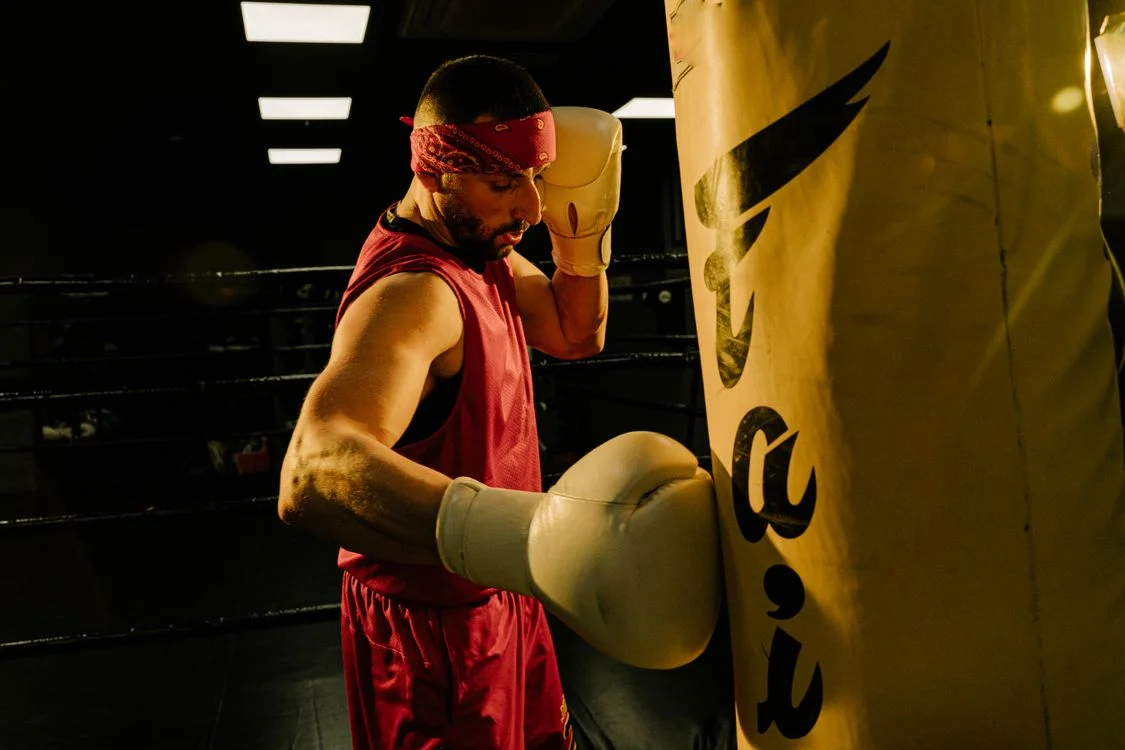
Start with shadowboxing only. If you buy a bag later, buy wraps and gloves with it, and never hit a bag with bare hands.
Which punches should you learn first?
Boxing has four basic punches. Learn them in this order, one at a time, before you try combinations.
- Jab (1). A quick, straight punch with your lead hand. It sets the range and starts nearly every combination. Snap it out and bring it straight back to your guard.
- Cross (2). A straight punch with your rear hand, powered by turning your back foot and hip. It is your hardest straight punch.
- Hook (3 and 4). A short, circular punch that travels sideways. The lead hook (3) and rear hook (4) both need your elbow bent at roughly a right angle.
- Uppercut (5 and 6). An upward punch aimed at the chin. The lead uppercut (5) and rear uppercut (6) come from a small dip of the knees, not from dropping your hands.
Power comes from the floor and your hips, not from your arms. If a punch feels like an arm punch, slow down, reset your stance and throw it again from the feet up. Coaches number the punches 1 to 6 so combinations are easy to call: 1-2 means jab-cross, 1-2-3 means jab-cross-lead hook. Learn the four punches first and the numbers will follow.
What does a beginner boxing session look like?
Every session follows the same shape boxers have used for generations: rounds of work with short rests between them. A round is 3 minutes, and the rest is 1 minute. Set a timer and let it run the session.
A first session has four rounds and takes about 20 minutes including warm-up and cool-down:
- Warm-up, 5 minutes. March or jog in place, circle your arms, bounce lightly in your stance. Build the pace slowly.
- Round 1, footwork. Move forward, back and side to side in your stance without crossing your feet. Throw a jab every few steps.
- Round 2, jab and cross. Work 1-2 combinations, stepping in to throw and stepping out again. Keep your hands up between punches.
- Round 3, add the hook. Work 1-2-3, then 1-2-3-2. Focus on clean technique, not speed.
- Round 4, conditioning. 30 seconds of fast straight punches, 30 seconds of squats, repeated three times.
- Cool-down, 5 minutes. Slow shadowboxing, then stretch your shoulders, hips and calves.
When you shadowbox, extend each punch to just short of straight. Snapping your arm out to a hard lockout with nothing to hit can strain your elbow. Three sessions a week with a rest day between them is the right starting dose.
How does the 4-week plan work?
The plan adds one round per week and one session when you are ready. Nothing else changes, so you can measure progress clearly.
| Week | Sessions per week | What changes |
|---|---|---|
| Week 1 | 2 | Foundation: stance, jab and cross only, 4 rounds per session |
| Week 2 | 2 to 3 | Add the hook and uppercut, 5 rounds per session |
| Week 3 | 3 | Full 6-round session, combinations 1-2-3 and 1-2-3-2 |
| Week 4 | 3 | 6 rounds plus skipping: 3 rounds of skipping (30 seconds on, 30 off), last round all-out |
If a week feels hard, repeat it. There is no prize for rushing to week 4 with sloppy punches. Add a round only when you can finish the current number with your guard up and your technique clean. If 3 minute rounds feel too long at first, start with 2 minute rounds and 1 minute of rest, then move to full rounds in week 2.
Should you train with a bag or shadowbox?
Both work, and they train different things. Most beginners should start with shadowboxing and add bag work later.
| Shadowboxing | Heavy bag | |
|---|---|---|
| Equipment | None | Bag, wraps and gloves |
| What it trains | Technique, footwork, speed and coordination | Power, timing and conditioning |
| Risk | Low, if you avoid hard lockouts | Higher, if you hit it without wraps or with poor form |
| Space | A small clear patch of floor | Needs a fixed hanging point or a free-standing bag |
| Best for | Your first 4 weeks | After your punches are clean |
Shadowboxing is a proper workout on its own. It is how boxers warm up, cool down and drill technique. A bag adds impact, which builds power and conditions your hands, but it also punishes bad form. Learn the punches in the air first, then take them to the bag.
What mistakes should beginners avoid?
Most beginners make the same five mistakes. All five are easy to fix once you know them.
- Dropping your hands. After every punch, bring your hand straight back to your guard. The habit matters more than the punch.
- Punching with your arms only. Turn your feet and hips into every punch. If your feet stay still, your punches stay weak.
- Hitting a bag without wraps. Wraps protect the small bones in your hands. No wraps, no bag.
- Training too hard, too soon. Four rounds, three times a week, beats one exhausting session that leaves you too sore to train again.
- Skipping footwork. Boxing is a footwork sport. If you only practise punches standing still, you will freeze the first time you need to move.
A mirror helps with the first two. Film yourself on your phone once a week and watch it back; you will spot dropped hands and flat feet faster than any amount of reading will.
How often should you train, and when should you see a coach?
Train two or three times a week, with a rest day between sessions. Four short sessions a week will build your skills faster than one long session, because you practise the movements more often. Take a full rest day if you feel joint pain, not just tired muscles.
Home training has a clear limit: it cannot teach you timing against a live opponent, and it cannot tell you when your technique is wrong. That is what a coach is for. If you can, book even one session at a local boxing club after your first few weeks. A coach will check your stance, your guard and your punches in ten minutes, and that check is worth more than a month of guessing. Do not arrange sparring at home, and do not ask a friend to test your defence by hitting you. Sparring belongs in a gym with a coach watching.
Frequently asked questions
Can I learn boxing at home without a bag?
Yes. Shadowboxing, footwork drills and bodyweight conditioning are a complete beginner routine. A bag adds power training later, but it is not needed to start.
How long should a beginner boxing session last?
About 20 to 30 minutes, including warm-up and cool-down. Four to six rounds of 3 minutes with 1 minute of rest is the standard structure.
How many times a week should a beginner train boxing?
Two or three times a week, with a rest day between sessions. Add a fourth session only when three feels easy.
Do I need hand wraps for shadowboxing?
No. Wraps are for bag work, where they protect your knuckles and wrists. For shadowboxing you need nothing on your hands.
What space do I need to box at home?
About 2 metres by 2 metres of clear floor is enough to move, step and punch. More space helps your footwork, but you can start small.
When am I ready to join a boxing gym?
Any time. A gym is worth joining after your first few weeks at home, when you know the basic punches and want a coach to check your technique before bad habits set in.
Conclusion
A beginner boxing routine at home is simple: three sessions a week, 3 minute rounds with 1 minute of rest, four punches learned in order, and one extra round each week. Start with shadowboxing, add skipping in week 4, and take your punches to a bag only when they are clean. Keep your guard up, your feet moving and your progress slow enough to be real. When you are ready for a coach to check your work, your local club is the next step, and the sports guides on BlogMags will keep you going between sessions.