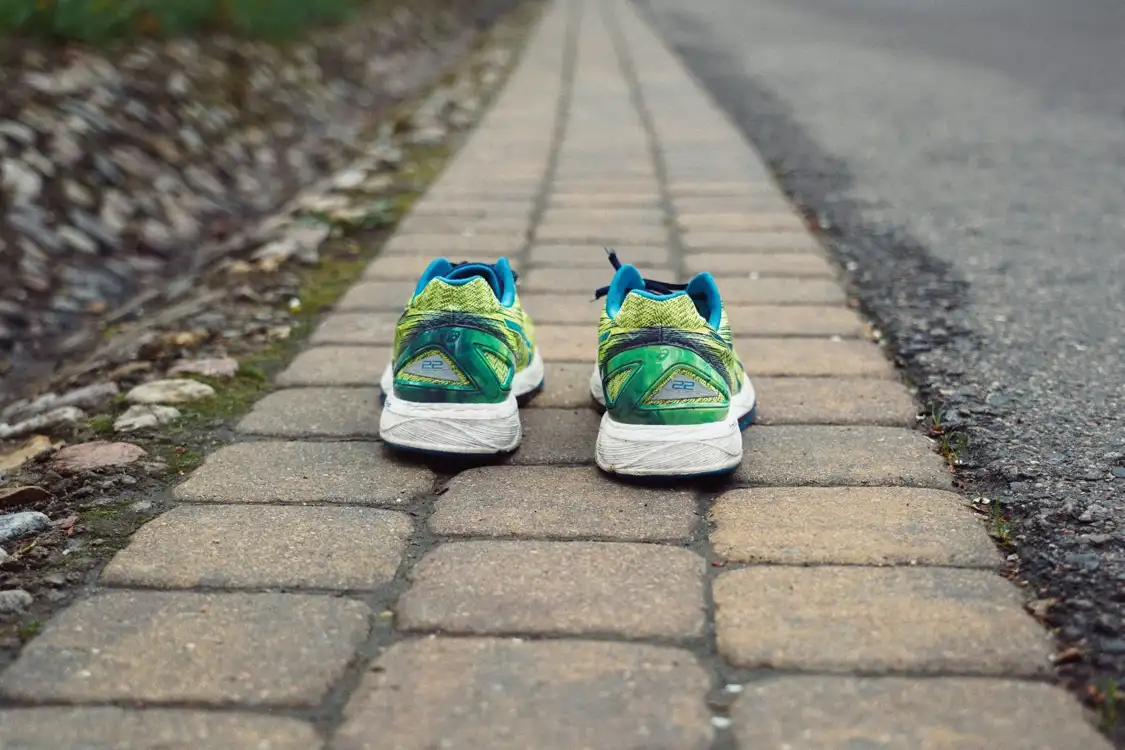
Direct answer: Start with where you run. For roads and pavements, buy a neutral cushioned road shoe. For muddy trails, buy a trail shoe with deeper grip. Try them on in the afternoon with your running socks, leave a thumb’s width at the toe, and pick the pair that feels comfortable on a short jog. Fit matters more than brand or price.
Choosing your first pair of running shoes can feel harder than the running itself. Neutral, stability, cushioning, drop, stack height: the labels pile up fast, and every brand claims its shoe is the one. The good news is that most beginners need a simple daily trainer, not a specialist shoe. This guide walks you through the four decisions that matter: surface, support, fit and cushioning. Get those right and the rest is personal taste.
Road or trail: where will you run?
Start with the ground under your feet, not the brand on the box. Running shoes are built for a type of surface, and the wrong type wears out fast or grips badly.
Road shoes suit pavements, tarmac paths in parks, treadmills and dry canal towpaths. They have a fairly smooth rubber outsole that grips well on hard ground and wears evenly. Trail shoes suit mud, grass, gravel, woodland paths and rocky ground. They have deeper lugs for grip, a tougher upper that resists scuffs, and often a firmer feel underfoot.
If you run on a mix, pick the shoe for the surface you run on most. A road shoe on a muddy trail will slip; a trail shoe on tarmac will feel stiff and wear its lugs down quickly.
| Feature | Road shoes | Trail shoes |
|---|---|---|
| Best for | Pavements, tarmac, treadmills, dry park paths | Mud, grass, gravel, woodland, rocky trails |
| Outsole | Smooth rubber, even wear on hard ground | Deep lugs for grip on soft and loose ground |
| Cushioning | Soft and plush, built for repeated impact | Firmer, more ground feel, less soft foam |
| Upper | Light and breathable mesh | Tougher, often water resistant, scuff proof |
| Weight | Usually lighter | Usually a little heavier |
| Watch out for | Slips on wet mud and grass | Lugs wear fast on tarmac, stiff on roads |
Most UK beginners start on roads. If your local parkrun is on tarmac or a firm path, a road shoe is the right first buy. Move to a trail shoe only when most of your miles are off road.
Do you need a neutral or a stability shoe?
Once you know the surface, the next choice is support. There are two main types.
A neutral shoe has no extra guidance built in. It suits most runners, and it is the sensible starting point if you have no history of knee or shin problems and your old trainers wear fairly evenly across the sole.
A stability shoe (sometimes called a support shoe) has firmer foam or a guide rail on the inside of the midsole. It suits runners whose feet roll inward more than usual when they land, a movement called overpronation. Signs that point that way are heavy wear on the inside edge of old shoes, or a history of aching arches, shins or knees when you run.
You do not need to know your gait type before you buy. A simple check is to look at the wear on an old pair of trainers. Even wear means neutral is a safe start. Heavy inside wear suggests trying a stability shoe. If you are unsure, a specialist running shop can watch you run and advise you; many offer this for free when you buy from them. Do not buy a stability shoe just because it sounds safer. Too much support can feel just as wrong as too little.
How should running shoes fit?
Fit matters more than any feature on the box. A shoe with the best foam in the world is useless if it pinches your toes or slips at the heel. Use this checklist when you try a pair on.
Try shoes on later in the day, when your feet are at their largest, and wear the socks you run in. Lace them up fully, stand up, and walk around. If the shop allows it, take a short jog in them. A running shoe should feel comfortable straight away. A shoe that needs weeks of breaking in is the wrong shoe. That rule is for running shoes: leather shoes are different, and if you are breaking in a leather pair, read our guide on how to break in new shoes.
| Fit check | What to look for | Red flag |
|---|---|---|
| Toe room | About a thumb’s width, roughly 1 cm, between your longest toe and the end of the shoe | Toes touch the end, or black toenails after runs |
| Length | Most runners go half a size up from everyday shoes, as feet swell on longer runs | Same size as your everyday shoes feels tight |
| Width | Toes can spread, widest part of your foot sits at the widest part of the shoe | Foot bulges over the edge of the sole, little toe squeezed |
| Heel | Held firmly, no lifting as you walk or jog | Heel slips up and down, or blisters at the back |
| Midfoot | Snug but not tight, no pressure on the top of the foot when laced | Laces dig in, or foot slides forward |
| Comfort | Feels good on a short jog in the shop, nothing rubs or pinches | Any hot spot, even a small one, will get worse |
Sizes vary between brands, so do not assume your size in one brand carries over exactly to another. Always go by how the shoe feels, not the number on the box. If you have wide feet, look for a wide fitting; several popular models now come in wide versions.
How much cushioning do you need?
Cushioning is how much soft foam sits between your foot and the ground. More is not automatically better. The right amount depends on how far you run and what feels good under your feet.
| Type | Best for | How it feels | Note for beginners |
|---|---|---|---|
| Light cushioning | Short runs, faster sessions, runners who like ground feel | Firm, close to the ground, lighter | Can feel harsh on longer runs |
| Moderate cushioning | Most beginners, daily runs, 5K to 10K | Balanced, protective without feeling bulky | The safest starting point |
| Maximum cushioning | Long easy runs, runners who want the softest ride | Very soft, high stack, protective | Can feel unstable on uneven ground, heavier |
For a first pair, moderate cushioning is the best bet. It protects your legs on easy runs without the weight or wobble of a maximum shoe. You can always try a softer or firmer shoe later, once you know what you like.
Two related terms you will see on the box are drop and stack height. Drop, also called offset, is the height difference between the heel and the forefoot, measured in millimetres. Traditional running shoes have a drop of around 8 to 12 mm, which takes some load off the calves and Achilles and suits runners who land on their heel. Low drop shoes, from 0 to 6 mm, put more work through the calves and Achilles. For a first pair, a drop around 8 to 10 mm is a safe, normal choice. Stack height is simply how much material sits under your foot; a higher stack feels softer, a lower stack feels closer to the ground. Neither number measures quality, so do not pick a shoe by its numbers alone.
How much should you spend?
You do not need the most expensive shoe to start running. Most beginners in the UK spend roughly 60 to 120 pounds on a first pair of daily trainers, and that buys a well made shoe from any major brand. Prices vary by brand, model and sale, so treat that range as a guide, not a rule.
A few ways to spend wisely: buy last season’s model of a popular trainer, which is often the same shoe with a new colour; avoid race day shoes and carbon plated racers, which cost more and wear faster; and spend your money on fit rather than features you do not need yet, such as waterproof membranes for summer road running. One pair is enough to start. If you run four or more times a week, a second pair later on lets the foam recover between runs and means you always have a dry pair in wet weather.
When should you replace your running shoes?
Running shoes do not last for ever. The foam that cushions your feet compresses with every mile, and the grip wears smooth. Most running shoes last roughly 300 to 500 miles, which is 500 to 800 kilometres. A beginner running 10 miles a week will get about a year from a pair; someone running 25 miles a week will need a new pair in about five months.
Watch for these signs rather than counting miles alone: the tread is smooth in the middle, the foam feels flat and hard instead of springy, the upper has torn, or you start getting new aches in your knees, shins or feet. Any one of these means it is time to shop again. When you do, start with the same model if you liked it; a newer version of the same shoe is usually a safe next buy.
Look after the pair you have. Rinse off mud after wet runs, stuff them with newspaper so they dry their shape, and never put them in a washing machine or tumble dryer. The gentle cleaning steps in our guide to cleaning white sneakers work for running shoes too, and clean, dry shoes last longer.
Common mistakes beginners make
The same errors turn up again and again in running shops. Avoid these and your first buy will be far easier.
Buying the same size as your everyday shoes is the most common mistake. Running shoes usually need half a size more, because feet swell as you run. Buying on looks is next: the brightest colour is rarely the best fit, and a shoe that looks fast but pinches is a waste of money. Buying a stability shoe without needing one is another; extra support you do not need can change how you run and cause new niggles. Skipping the jog test matters too: always jog in the shop if you can, because a shoe that feels fine standing still can rub once you move. Finally, do not buy trail shoes for road running, or road shoes for muddy trails. Match the shoe to the ground you run on most, and the rest follows.
Frequently asked questions
Do I need to spend a lot on my first running shoes?
No. A first pair of daily trainers in the UK usually costs roughly 60 to 120 pounds, and that buys a well made shoe. Fit matters far more than price, so a cheaper shoe that fits well beats an expensive one that pinches.
Should running shoes be a size bigger?
Often half a size bigger than your everyday shoes. Feet swell during a run, so leave about a thumb’s width between your longest toe and the end of the shoe. Always go by fit, not the number on the box.
What is the difference between neutral and stability shoes?
A neutral shoe has no extra guidance and suits most runners. A stability shoe has firmer foam or a guide rail on the inside that supports feet which roll inward more than usual. Start with neutral unless your old shoes wear heavily on the inside edge.
Can I use the same shoes for road and trail?
Not well. Road shoes have smooth soles that slip on mud, and trail shoes have deep lugs that wear fast and feel stiff on tarmac. Buy the shoe for the surface you run on most.
How do I know when my running shoes are worn out?
Most last roughly 300 to 500 miles. Signs include smooth tread, flat and hard foam, a torn upper, or new aches in your knees, shins or feet. Any one of these means it is time for a new pair.
Do I need a gait analysis before buying running shoes?
No, it is not essential. You can start with a neutral road shoe and the fit checklist in this guide. A gait analysis at a specialist running shop is useful if you are unsure, or if you keep getting niggles when you run.
Conclusion
Choosing running shoes for beginners comes down to four steps: pick road or trail for the ground you run on, start with a neutral shoe, check the fit with a thumb’s width at the toe, and choose moderate cushioning. Try them on in the afternoon with your running socks, jog in the shop, and buy the pair that feels comfortable straight away. The best running shoe is the one that fits your foot and feels good when you run. For more beginner guides, browse our sports section.