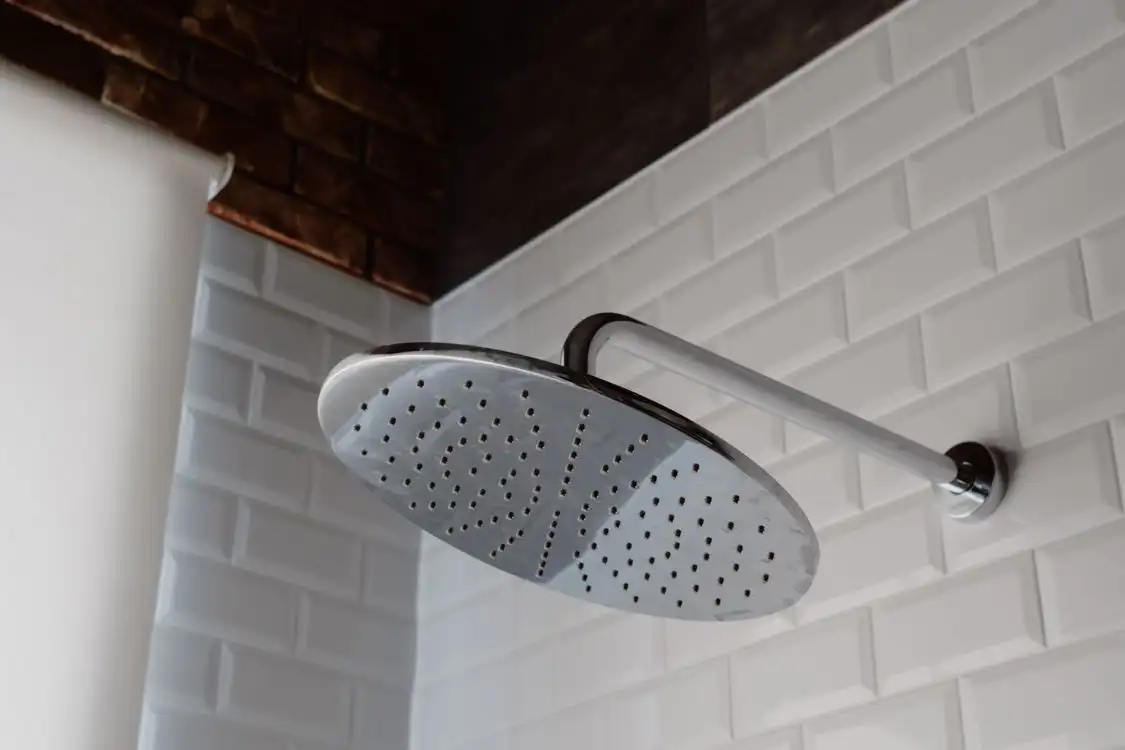
To descale a shower head, soak it in a citric acid solution, two tablespoons per litre of hot water, for 30 to 60 minutes, then brush the nozzles with a toothbrush and rinse it. For a fixed head, tie a bag of the same solution around it. White vinegar works too, but it is slower and can damage some finishes.
A shower head that used to give a strong, even spray does not wear out overnight. What happens is slower than that: every time a droplet of water dries on the faceplate, it leaves a tiny trace of chalk behind. Over weeks and months those traces build into limescale, the white crust that blocks the nozzle holes one by one. The spray goes sideways, some holes stop altogether, and the shower feels weak even though the water pressure in the house has not changed. Descaling is a 30 minute job with ingredients from the kitchen cupboard, and this guide covers how to tell limescale from a real pressure problem, which method actually works, how to protect your finish, and what to check when the pressure stays low after a perfect soak.
Is it limescale or low pressure?
Do not start descaling until you know the problem is scale. A weak shower can have several causes, and soaking a shower head will not fix a supply problem. Use the table below to diagnose first, because it takes two minutes and saves you soaking a head that was never the problem.
| What you notice | Likely cause | What to do |
|---|---|---|
| White crust on the faceplate, some holes blocked, spray going sideways | Limescale in the nozzles | Descale it, using the method below |
| All taps in the house run slowly, not just the shower | Low mains pressure or a supply problem | Do not descale; check other taps and call your water supplier if they are all slow |
| Shower was fine, then suddenly weak after plumbing work | Debris in the pipe or a partly closed valve | Check the shower isolator valve is fully open |
| Pressure fine at first, then fades during the shower | Blocked inlet filter or a failing thermostatic cartridge | Descale first, then check the inlet filter in the section below |
| Spray strong on some settings, weak on others | Scale in some nozzle rows, or a worn spray selector | Descale it, then test every spray setting |
The bucket test proves whether the descale worked, and it costs nothing. Before you start, hold a 1 litre measuring jug under the shower head with the shower running at full power and time how long it takes to fill. Write the time down. After descaling, repeat the same test at the same setting. If the jug fills noticeably faster, the scale is gone and the fix is proven. If the time is the same, the nozzles were not the problem, and the inlet filter section below is your next step. Do not guess at the improvement; the jug gives you a number you can compare.
Which method actually works?
Three household options get mentioned for descaling, but they are not equal. One of them cannot dissolve limescale at all, and several guides still recommend it. The table below compares them honestly, so you can pick the right one for your shower head and your finish.
| Method | How it works | Best for | Watch out |
|---|---|---|---|
| Citric acid | Acid dissolves the calcium carbonate and holds the calcium in solution so it cannot settle back | Heavy, long-standing build-up; the strongest household option | Keep soak times short on delicate finishes; see the finish table below |
| White vinegar | Acetic acid breaks the crust down into calcium acetate, which rinses away | Light to moderate build-up; the forgiving default | Slower than citric acid; use distilled white vinegar only, never malt or brown |
| Baking soda | It does not dissolve limescale; it is alkaline and only polishes the surface | Cleaning the outside of the faceplate, nothing more | Mixing it into vinegar cancels the acid, so never combine the two |
| Shop-bought descaler | Ready-mixed acid, usually citric or lactic acid, made for the job | Very heavy build-up that household methods have not shifted | Follow the label exactly for dilution and contact time; never mix with bleach |
Citric acid is the best choice for most homes. It is the strongest of the household options, it has no smell, and it is cheap: a tub of food-grade citric acid powder from a supermarket or hardware shop costs a few pounds and lasts for many descales. White vinegar is the fallback when you do not have citric acid in the cupboard; it works, it just takes longer. Baking soda has no place in a descaling soak, and any guide that tells you to soak a shower head in baking soda is repeating a myth. Use it as a gentle paste on the outside of the faceplate if you like, but do not expect it to clear a blocked nozzle.
How to descale a handheld shower head
A handheld shower head unscrews from the hose, which makes the whole job easier. You can submerge it fully in a bowl, so the solution sits inside the nozzle holes where the scale actually is. A bag tied around a fixed head only half achieves this, so if your head comes off, take it off.
1. Turn the shower off and let the head cool if it has just been used. A hot head is awkward to hold and the solution works no better on a hot fitting.
2. Unscrew the shower head from the hose by hand, turning it anti-clockwise. If it is stiff, wrap a cloth around it first for grip. Do not use pliers on a chrome fitting, or you will scratch it. Keep the rubber washer that sits between the head and the hose; it stops leaks when you refit it.
3. Mix the solution in a bowl or bucket. For citric acid, dissolve two tablespoons of powder in a litre of hot, but not boiling, water. For vinegar, use one part distilled white vinegar to one part warm water. Use a plastic container, not an unlined metal one.
4. Put the shower head in the bowl face down, so the nozzles are fully under the solution. Leave it for 30 to 60 minutes. Check the finish table below first; matte black and brass need a shorter soak.
5. Lift the head out and brush the faceplate with an old toothbrush. Work across the nozzles gently, and use a wooden toothpick or a pin for any hole that is still blocked. If your head has soft silicone nozzles, rub them with your thumb; the rubber flexes and pops hardened plugs straight out.
6. Rinse the head thoroughly under running water, then refit it to the hose with the rubber washer back in place. Tighten it by hand, and do not over-tighten.
7. Run the shower for a minute with the head pointing into the bath or shower tray, to flush out any loose flakes. Then repeat the bucket test and compare the time with the one you wrote down before.
How to descale a fixed shower head
A fixed head cannot come off the wall, so you bring the solution to it instead. The bag method works well as long as the bag is strong and tied properly, and the nozzles stay submerged for the whole soak.
1. Turn the shower off and let the head cool. Put an old towel in the bottom of the bath or shower tray to catch any drips.
2. Mix the same solution as above in a jug: two tablespoons of citric acid per litre of hot water, or one part distilled white vinegar to one part warm water.
3. Pour the solution into a strong, large plastic bag, a freezer bag or a zip-lock bag, and lift it up around the shower head so the faceplate and nozzles are fully under the liquid. Use enough solution to cover the nozzles, not the whole fitting.
4. Tie the bag firmly to the shower arm with elastic bands or string, and check the seal. A bag that slips off halfway through the soak wastes the job, so tug it gently to make sure it holds.
5. Leave it for 30 to 60 minutes, checking the finish table below for your head. Do not leave a bag on overnight; a long soak is not better, and on some finishes it can cause damage.
6. Untie the bag carefully over the bath, so the solution does not splash on you, and pour it away. Brush the nozzles with an old toothbrush, rub silicone nozzles with your thumb, and use a toothpick on any hole that is still blocked.
7. Run the shower for a minute to flush the head, then repeat the bucket test at the same setting as before and compare the times.
If the shower head is fixed to the ceiling and the bag will not stay up, spray the solution onto the faceplate from a spray bottle instead, leave it for 15 to 20 minutes, scrub, and repeat. It takes more passes than a soak, but it works on light build-up.
Which solution is safe for your finish?
The wrong acid on the wrong finish can do damage that outlasts any limescale. A short soak in vinegar is fine on chrome, but the same soak can dull matte black or eat into brass. Check your finish against the table before you mix anything, and if you are not sure what finish you have, use the baking soda paste, which is the safe option for every finish.
| Finish | Safe solution | Maximum soak time |
|---|---|---|
| Chrome | White vinegar, or citric acid | Vinegar up to 30 minutes; citric acid 15 to 20 minutes |
| Stainless steel | White vinegar, or citric acid | Up to 30 minutes for either |
| Plastic | White vinegar, or citric acid | Up to 30 minutes for either |
| Matte black | Baking soda paste only | No more than 15 minutes |
| Brushed brass, plated | Baking soda paste only | No more than 15 minutes |
| Solid brass | 50/50 white vinegar and water | No more than 10 minutes |
| Not sure what it is | Baking soda paste | No more than 15 minutes |
To make a baking soda paste, mix about three parts baking soda with one part water until it is thick enough to stay on the faceplate. Spread it over the nozzles, leave it for up to 15 minutes, then scrub gently with a soft toothbrush and rinse. Remember that the paste only cleans the surface; it will not dissolve scale inside the holes. On a matte black or plated brass head, that is the trade-off you accept to protect the finish, and you may need to repeat the treatment or use a toothpick on stubborn holes.
Never use malt vinegar or brown vinegar. It is less effective than distilled white vinegar, and it can stain a light-coloured fitting. Never use a harsh chemical cleaner or an abrasive pad on a shower head, because both will scratch the finish and the scratches will hold limescale even faster next time. And never mix vinegar, citric acid, or any descaler with bleach or another cleaner. The mixture can release hazardous fumes, so use one product at a time and rinse well between products.
What if the pressure is still low after descaling?
A perfect soak does not always fix a weak shower, and that does not mean you did it wrong. If the bucket test shows the same time as before, the blockage is somewhere else in the line, and the most common culprit is the inlet screen washer.
The inlet filter is a small mesh washer that sits where the shower head joins the arm, or where the hose joins the mixer. It catches grit and sediment before it reaches the nozzles, and over time it clogs with the same debris it is meant to stop. Unscrew the head, lift the washer out, and rinse it under a running tap, brushing it gently with an old toothbrush. If it is torn or clogged solid, replace it; washers cost pennies from a hardware shop and come in standard sizes.
If the filter is clean and the pressure is still low, check the shower hose for kinks, and check that the isolator valve on the shower supply is fully open. A thermostatic mixer that fades during a shower can also mean a failing cartridge, which is a plumber’s job, not a cleaning job. And if every tap in the house is slow, the problem is the mains supply, not the shower head at all.
How to stop limescale coming back
Descaling fixes the shower head, but it does not change the water. In a hard water area, the scale starts building again the next time you shower, so prevention is about slowing it down, not stopping it for good.
Wipe the shower head dry after use where you can, because limescale forms when standing water evaporates on the faceplate. It takes ten seconds with a dry cloth, and it makes the biggest difference of any habit. Rub silicone nozzles with your thumb once a week while the shower is running; the flex pops out early deposits before they harden. Repeat a light descale every 1 to 3 months, monthly if your water is very hard, rather than waiting until the spray goes sideways. A quick 15 minute soak every few months is easier than a long battle with a badly scaled head.
If your water is very hard, consider a filter shower head with anti-clog silicone nozzles, which are easier to keep clean, or a water softener for the whole house. A softener is a bigger investment, but it protects every tap, the kettle, and the heating system as well as the shower. For more on limescale around the home, see our guide to how to bleed a radiator, which covers the boiler pressure check that goes with a healthy heating system.
Hard water and damp often appear together in UK bathrooms, because a weak shower leaves more water sitting on the tiles. If you have damp patches as well as a scaled shower head, read our guide to damp in house, and if black spots have appeared around the shower, our guide to how to remove mould from walls shows how to clean them safely.
For more home guides, see our home-improvement section.
Frequently asked questions
How long should I soak a shower head in vinegar?
Between 30 minutes and one hour for a chrome, stainless steel or plastic head, using distilled white vinegar mixed one part vinegar to one part warm water. Do not soak a brass head in vinegar for longer than 30 minutes, and keep a matte black or plated brass head out of vinegar altogether; use a baking soda paste instead.
Is citric acid or vinegar better for descaling a shower head?
Citric acid is better for heavy build-up. It is stronger than vinegar, it has no smell, and it holds the dissolved calcium in solution so it cannot settle back on the nozzles. Mix two tablespoons of powder per litre of hot water and soak for 30 to 60 minutes. Vinegar is the forgiving fallback when you do not have citric acid, but it works more slowly.
Can I use baking soda to descale a shower head?
No. Baking soda is alkaline, so it cannot dissolve limescale, which is calcium carbonate. It only polishes the surface of the faceplate. It is useful as a paste on delicate finishes like matte black, where acids are not safe, but do not expect it to clear blocked nozzle holes, and never mix it into vinegar, because that cancels the acid.
How do I descale a shower head without removing it?
Fill a strong plastic bag with the citric acid or vinegar solution, lift it around the head so the nozzles are submerged, and tie it firmly to the shower arm with elastic bands or string. Leave it for 30 to 60 minutes, then untie it over the bath, brush the nozzles, and run the shower to flush it out.
How often should I descale my shower head?
Every 1 to 3 months in a hard water area, and monthly where the water is very hard. A short soak every few months is far easier than waiting until the spray goes sideways and the holes are blocked solid. Wiping the head dry after each shower stretches the gap between descales.
Why is my shower pressure still low after descaling?
The blockage is probably the inlet screen washer, the small mesh washer where the head joins the arm. Unscrew the head, lift the washer out, rinse it under a tap and brush it clean. If the filter is clean and every tap in the house is slow, the problem is the mains supply, not the shower head, and a plumber or your water supplier should look at it.