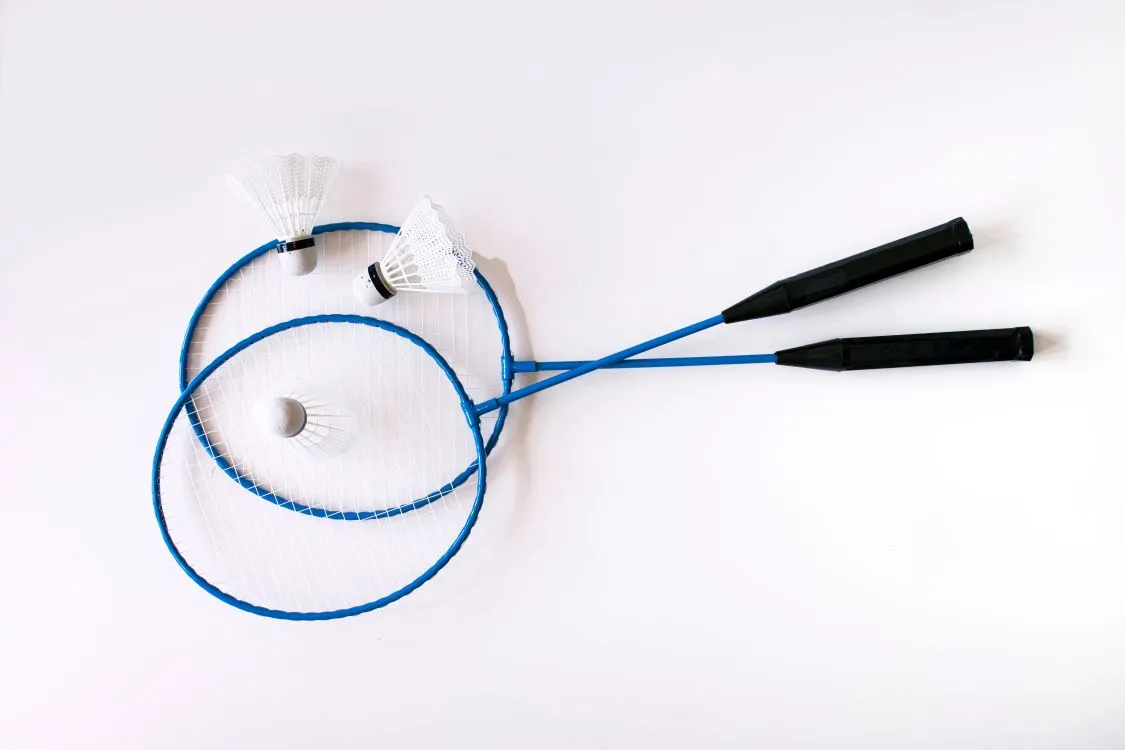
Choose a 4U racket (80 to 84 grams) with even balance, a flexible shaft, a G5 grip and factory stringing at 20 to 24 lb. That set-up is light, forgiving on mistimed shots and easy on the arm. Spend £20 to £50 on a full graphite frame, and upgrade only once you play weekly and know your style.
Picking your first badminton racket feels harder than it should. Every product page lists numbers you have never seen before, U ratings, balance points, flex ratings and G numbers, and the shop assistant will happily sell you the racket a county player uses. That is exactly the racket you should not buy. A beginner needs a racket that helps a developing swing, not one that punishes it. This guide explains the four numbers that decide how a racket plays, gives you a simple decision table so you can choose in five minutes, covers what to spend in pounds, and answers the stringing question every beginner asks. It is written for UK players buying their first racket, with no product roundup and no shop links, because the right choice is about the specification, not the brand on the frame.
Racket weight: the U rating
Weight is the first number to get right, because it decides how fast you can swing and how tired your arm gets over a full game. Badminton rackets are graded with a U number, and the scale runs backwards: the higher the U number, the lighter the racket. The weights below are for the unstrung frame, before strings and grip are added.
| Weight class | Unstrung frame weight | Who it suits |
|---|---|---|
| 2U | 90 to 94 g | Strong, experienced hitters who want stability |
| 3U | 85 to 89 g | Singles players and attacking players who want smash power |
| 4U | 80 to 84 g | Most club players, the most common grade, and the safe beginner choice |
| 5U | 75 to 79 g | Beginners, juniors and fast doubles players |
For a beginner, 4U is the default. It is quick enough for flat doubles exchanges while still carrying enough mass for clears from the back of the court. A 5U frame is also a fair choice if you have a smaller build, play mostly doubles at the front, or have a shoulder that complains after a long session. A 3U frame is heavier and gives more momentum on smashes, but it will tire a new player’s arm and slow the racket down at the net. Do not start with a 2U frame.
Remember that the number on the box is not the weight you play with. Strings add roughly 3 to 5 g and a grip adds 5 to 10 g, so a 4U racket can weigh more than 90 g in playing condition. That is normal and nothing to worry about. What matters is the class, not the gram on a kitchen scale. If you are unsure between two classes, choose the lighter one. A lighter racket is easier to learn with, and you can always move up in weight later when your swing is stronger.
Balance: head-heavy, even or head-light
Two rackets of the same weight can feel completely different, because balance decides where the mass sits. Balance is measured in millimetres from the butt cap at the end of the handle. Around 285 to 295 mm is even balance, above about 295 mm is head-heavy, and below about 285 mm is head-light.
A head-heavy racket carries its weight towards the head, so it adds momentum to smashes and clears from the back of the court. It suits attacking singles players with a full, fast swing. The trade-off is speed: it is slower to bring back up for defence and slower at the net. A head-light racket carries its weight towards the handle, so it is quick and easy to whip around for net play, drives and fast defence. It suits doubles players, front-court players and beginners. An even-balance racket sits in the middle and does a bit of everything, which is why it is the best starting point when you have not settled on a style yet.
You can test balance in the shop without any tools. Lay the racket flat across one finger near the join between the shaft and the head. If it tips towards the head, it is head-heavy. If it tips towards the handle, it is head-light. If it stays level, it is even. Some brands follow a pattern across their ranges, which helps you read a spec sheet. In the Yonex range, for example, Nanoflare frames are head-light, Astrox frames are head-heavy and Arcsaber frames are even balance. Other brands use their own names, so always check the balance figure rather than guessing from the name.
Shaft flex: match it to your swing
The shaft bends during the swing and springs back at contact, and how much it bends changes how the racket feels. This is the specification beginners get wrong most often, because a stiff shaft sounds better. It is not better for a beginner.
A flexible shaft bends more and returns energy for you, which generates power from a slower, shorter swing. It is forgiving on timing, so a shot that is slightly late still travels. That is exactly what a beginner needs. A medium flex suits most improving club players. A stiff shaft bends less and only returns energy to a fast, well-timed swing, giving precision to advanced players but robbing a slower swing of power. If your swing is not yet fast and consistent, a stiff shaft will make your clears fall short and your arm work harder for every shot.
The rule to remember is simple: slow swing points to flexible, fast swing points to stiff. As a beginner, choose flexible or medium flex. Never buy a stiff pro frame because a better player uses one. Stiff pro frames demand a swing a beginner does not yet have, and they can cause shoulder and elbow strain. One well-known example is the Yonex Astrox 100ZZ, an extreme-stiff pro frame that frustrates club players and strains the arm. The frame is not bad, it is simply built for a different player.
Grip size: the G rating and the finger test
Grip size decides how freely your fingers can work, and badminton is a finger game. Quick grip changes between forehand and backhand, and the small finger movements that steer the shuttle, all depend on a handle that fits your hand.
Grip sizes are labelled with a G number. On Yonex rackets the range runs from about G4 to G6, and a higher number means a thinner handle, so G5 is thinner than G4. Other brands use similar scales, so check the brand’s own chart if you buy a different make. Thinner handles help finger control and quick grip changes. Thicker handles suit larger hands and reduce how hard you have to squeeze.
The finger test is the quickest way to check fit in the shop. Hold the racket as if you are about to play a forehand, and look at the gap between your fingertips and your palm. There should be about a finger’s width of space. If your fingertips dig into your palm, the grip is too small. If the gap is much wider than a finger, the grip is too big. Most adult beginners should start with a G5 handle. If it feels slightly thin, add an overgrip, which is a thin wrap that builds the handle up a little and is cheap to replace. It is much easier to make a thin grip thicker with an overgrip than to make a thick grip thinner, so start on the smaller side.
Also check the grip material. A towel grip absorbs sweat and feels secure, but it wears out faster and needs replacing. A synthetic grip lasts longer and is easier to wipe clean. Either is fine for a beginner, and an overgrip lets you change the feel without buying a new racket.
Strings and tension: what a beginner needs
Strings are half the racket, and they are the part beginners worry about most. The good news is that you can ignore them for your first racket. Most entry-level rackets come factory strung, and that stringing is fine for learning. Do not pay extra for a restring before you have played a few sessions.
When you do restring, tension is the number that matters, measured in pounds. A common beginner range is 20 to 24 lb. Lower tension gives a larger sweet spot, more repulsion and more power, and the strings last longer. Higher tension gives more control and a crisper feel, but the sweet spot shrinks and strings break more easily. Beginners should stay at the lower end of the range, because a bigger sweet spot forgives shots that do not hit the centre of the strings, and that is most shots when you are learning.
Tension matters more than the brand of string. A fresh restring at the right tension will change how a racket feels far more than a famous string at the wrong tension. When your factory strings start to feel dead or lose tension, which happens after a few months of regular play, take the racket to a local sports shop or club stringer and ask for 20 to 22 lb. That is a sensible first restring for a beginner, and it costs far less than a new racket.
Can you string your own racket?
You can, but you should not try it as a beginner. Stringing a racket needs a stringing machine, which clamps the frame and pulls each string to an exact tension, and a machine costs far more than a year of paying a stringer. It also needs practice: a badly strung racket can warp the frame, and uneven tension makes the racket play badly and breaks strings quickly.
The practical answer is to use a local stringer. Most sports shops and many badminton clubs offer restringing, and the price is small compared with the cost of a racket. Ask for 20 to 22 lb, and ask the stringer to check the frame and grommets at the same time, because worn grommets cut strings. If you later play several times a week and want to learn, a basic stringing course and a second-hand machine are a hobby for the future, not a first step. For now, spend your money on court time and a decent pair of court shoes instead.
How much should a beginner spend?
A beginner is fine with a racket in the £20 to £50 range, and a good first racket does not need to cost more than that. The table below shows what each price band buys, so you can see where the extra money goes and decide whether it matters to you yet.
| Price band | What you get | Who it suits |
|---|---|---|
| Under £20 | Aluminium or steel shaft, heavy frame, basic strings | Occasional garden games, not regular club play |
| £20 to £50 | Full graphite frame, factory strung, even balance and flexible shaft available | The right first racket for most beginners |
| £50 to £100 | Better graphite, lighter frame, nicer feel, more balance options | Players who play weekly and want a step up |
| Over £100 | Pro-level frames, stiff shafts, specialist balance | Advanced players, not beginners |
The jump from under £20 to the £20 to £50 band is the one that matters, because it takes you from an aluminium shaft to a full graphite frame. Almost all serious rackets are full graphite, and aluminium-shaft rackets are entry level only: they are heavier, they transmit more shock to your arm, and they feel dead on contact. The jump from £50 to £100 buys a nicer feel and a lighter frame, but it will not make a beginner play better. Spend the difference on court fees and a few coaching sessions instead, and upgrade the racket once you play weekly and know whether you attack or defend.
Buy from a shop where you can hold the racket if you can. Weight and balance are numbers on a page until you feel them in your hand, and two rackets with the same specification can feel different. If you buy online, buy from a UK retailer with a returns policy, check the specification table carefully, and measure the grip with the finger test as soon as it arrives.
Rackets for juniors
Children need a different racket, not just a lighter adult one. Adult rackets are usually 665 to 675 mm long, which is too long for a child to swing properly. Junior rackets are shorter than 600 mm and lighter, at 50 to 70 g, with smaller grip sizes to fit small hands.
Buy the length for the child’s height, not their age, and check the maker’s size guide before you buy. A racket that is too long forces a child to grip the shaft instead of the handle, which builds bad habits that are hard to fix later. A racket that is too heavy tires a child’s arm and takes the fun out of the game. Start with a light, flexible junior frame, and move up in length as the child grows. The same rules apply: even balance, flexible shaft, factory stringing, and no pro frames.
The quick decision table
If you want to choose in five minutes, find your row in the table below and buy that specification. Every row is a safe beginner choice, and the differences between them are small compared with the difference between a right-sized racket and a wrong one.
| You are | Weight | Balance | Flex | Grip | Strings |
|---|---|---|---|---|---|
| Complete beginner, any style | 4U | Even | Flexible | G5 | Factory strung, 20 to 24 lb |
| Casual doubles, front court | 4U or 5U | Head-light | Flexible | G5 | Factory strung, 20 to 24 lb |
| Improving club player | 4U | Even | Medium | G5 | 20 to 24 lb |
| Attacking singles player | 3U or 4U | Head-heavy | Medium | G5 | 22 to 24 lb |
| Defensive doubles player | 4U or 5U | Head-light | Medium | G5 | 20 to 24 lb |
| Junior player | 50 to 70 g junior frame | Even | Flexible | Junior grip | Factory strung |
If you are still unsure after reading the table, buy the first row: 4U, even balance, flexible shaft, G5 grip, factory strung. It is the safest choice for most players, and it is far better to pick a well-balanced, forgiving racket and start playing than to spend weeks comparing specifications. Your game will tell you what to change next, and by then you will know your own style.
Mistakes beginners make when buying a racket
The most common mistake is buying a pro racket. A stiff, head-heavy frame built for a county player will make a beginner play worse, not better, because the frame demands a swing the beginner does not yet have. It also risks shoulder and elbow strain. Buy for the player you are now, not the player you want to be.
The second mistake is buying the heaviest racket in the shop. Extra weight feels powerful in the hand, but over a full game it slows your swing, tires your arm and makes your defence late. Light and quick beats heavy and slow for a beginner.
The third mistake is spending too much. A £150 racket does not fix a £20 swing. Put the money into court time, and let your game decide when an upgrade is worth it.
The fourth mistake is ignoring the grip. A handle that is too thick stops your fingers working, and a handle that is too thin makes you squeeze too hard, which causes blisters and arm strain. Do the finger test before you buy, and use an overgrip to fine-tune the fit.
The fifth mistake is buying a racket with the wrong strings and never changing them. Factory strings go dead after a few months of regular play, and a racket with dead strings feels dull and unresponsive. A fresh restring at 20 to 22 lb costs little and makes an old racket feel new again.
Finally, do not buy a racket you cannot return. If you buy online, check the returns policy before you pay, and test the grip and the swing as soon as it arrives. A racket that feels wrong in your living room will feel worse on court.
Looking after your first racket
A racket is not fragile, but it does need basic care. Keep it in a cover when it is in your bag, because a knock against a hard object can crack the frame. Do not leave it in a hot car or next to a radiator, because heat can weaken the frame and the strings. Wipe the grip after play, and replace the overgrip when it gets slippery. Store it somewhere dry, and if you want more storage ideas for all your kit, read our guide on how to store sports equipment at home. A well-kept racket lasts for years, and the money you save goes towards court time.
Frequently asked questions
What is the best badminton racket for a beginner?
A 4U racket with even balance, a flexible shaft, a G5 grip and factory stringing at 20 to 24 lb. That specification is light, forgiving and easy on the arm, and it suits most adult beginners. Spend £20 to £50 on a full graphite frame, and upgrade only once you play weekly and know your style.
What weight racket should a beginner use?
A 4U racket, which weighs 80 to 84 g before strings and grip, is the safe choice for most adult beginners. A 5U racket at 75 to 79 g is also fair if you have a smaller build, play mostly doubles, or have a shoulder that complains. Avoid 3U and heavier frames until your swing is stronger.
What grip size should I choose?
Start with a G5 handle, which suits most adult hands. Check the fit with the finger test: hold the racket as if playing a forehand and there should be about a finger’s width between your fingertips and your palm. If the grip feels thin, add an overgrip to build it up.
What string tension is best for a beginner?
A tension of 20 to 24 lb is the common beginner range, and 20 to 22 lb is a sensible first restring. Lower tension gives a larger sweet spot and more power, and the strings last longer. Most first rackets come factory strung, which is fine for learning.
How much should I spend on my first badminton racket?
Between £20 and £50 buys a full graphite frame that is right for most beginners. Rackets under £20 usually have an aluminium shaft and are only fit for occasional garden games. Rackets over £100 are pro-level frames that a beginner does not need.
Can I string my own badminton racket?
You can, but it needs a stringing machine and practice, and a badly strung racket can warp the frame. As a beginner, use a local sports shop or club stringer and ask for 20 to 22 lb. If you want to learn more about string tension first, read our guide on how to choose badminton string tension.
Choosing your first racket is a small decision with a big effect on how much you enjoy the game. Get the weight, balance, flex and grip right, and the racket disappears in your hand so you can focus on playing. If you are picking up other kit at the same time, our guide on how to choose running shoes for beginners covers the other half of your first kit bag, and the sports hub has the rest of our sports guides.